GEOTECHNICAL ENGINEERING
OTTAWA
HomeSlopes & WallsActive/passive anchor design

Active and Passive Anchor Design in Ottawa

Rigorous testing. Clear reporting.

LEARN MORE

A common mistake in Ottawa basement and cut-and-cover work is treating Leda clay as a uniform material. A single bond length assumption across Champlain Sea deposits will fail — sometimes within weeks of lock-off. We see this most often in the west end near the Rideau River, where sensitive clay lenses sit directly above till. Active anchor design here must adjust for time-dependent creep before the slope stability evaluation even begins. Our approach ties tendon free length, grout-to-ground friction, and lock-off load back to site-specific stratigraphy. For excavations deeper than 6 m in Gatineau Hills colluvium, we also require a deep excavation monitoring plan before finalizing anchor layout, since block movement in weathered rock can shear passive anchors if head details are too rigid.

Anchor creep in Ottawa's Leda clay can continue for 72 hours post-lock-off — early re-stressing prevents up to 15% load loss.
Our service areas

Scope of work

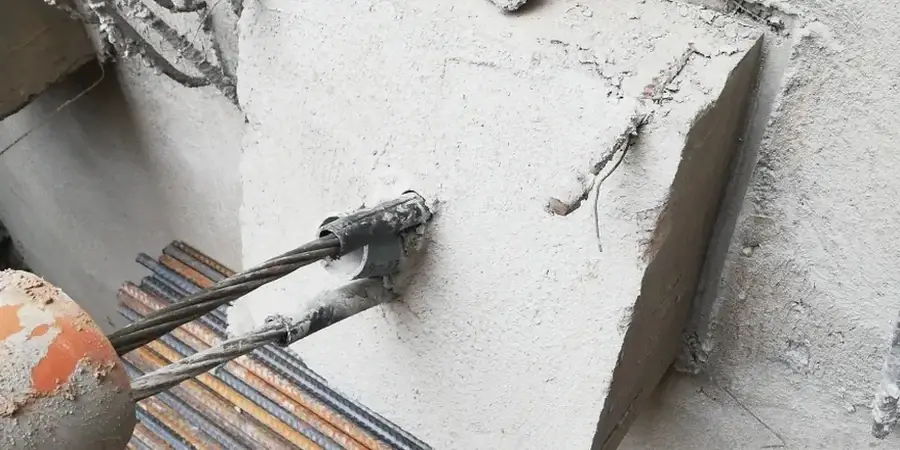
The anchor assembly itself starts with a 15.2 mm seven-wire strand conforming to CSA G279 steel, fed through a corrugated HDPE sheath and centralizer spaced at 2 to 3 m. At the Ottawa lab, we run bond-length pull-out tests on a hydraulic hollow-ram jack and dial gauge setup capable of 1,500 kN, recording displacement at 0.5 mm increments. Active anchors receive an initial lift-off check 24 hours post-grouting, then a lock-off load set to 80% of design load, with a second check at seven days to catch relaxation in the clay. Passive anchors — common in rock sockets across the Canadian Shield outcrops near Greenbelt zones — rely instead on bar tendons and double-corrosion protection, with a grout column designed to transfer load gradually along the bond zone. Both types are verified against CSA A23.3 Annex D and PTI DC35.1 for unbonded length requirements.
Active and Passive Anchor Design in Ottawa
Technical reference — Ottawa

Area-specific notes

Ottawa crews sometimes assume that a passive rock anchor will not move — but in the limestone–shale interbeds under the downtown core, progressive shearing along a weak shale seam can delaminate the bond zone silently. We have mapped this pattern in excavation pit walls near the Lyon Street LRT station alignment. A passive anchor installed into a 200 mm shale layer sandwiched between competent limestone can lose 40% of its capacity without any visible surface distress. The fix is not a longer anchor: it is a pre-qualification bond-zone core and a staged proof-load sequence. Active anchors carry their own risk: if the lock-off pressure is applied too early — before the primary grout has reached 20 MPa — the wedge set can slip inside the anchor head, requiring complete replacement of the tendon. Both failure modes are preventable through a tight QA/QC schedule and a clear lock-off window defined by grout maturity, not by calendar day.

Need a geotechnical assessment?

Reply within 24h.

Email: contact@geotechnicalengineering.vip

Standards used


CSA A23.3: Design of Concrete Structures (Annex D — Anchoring), PTI DC35.1: Recommendations for Prestressed Rock and Soil Anchors, ASTM A416/A416M: Low-Relaxation Seven-Wire Steel Strand, CSA G279: Steel for Prestressed Concrete, CSA A23.1: Concrete Materials and Methods of Concrete Construction

Technical data

ParameterTypical value
Strand grade (active)CSA G279 Grade 1860 MPa
Bar grade (passive)CSA G30.18 400W or 500W
Typical bond length in clay6 to 12 m per strand
Typical bond length in rock3 to 6 m per bar
Grout strength at 7 daysMinimum 30 MPa (CSA A23.1)
Sheath corrugation depth1.5 mm minimum (HDPE)
Proof load test133% of design load (1 hour hold)
Free length minimum4.5 m or 1.2 x excavation depth

Common questions


What is the typical cost range for anchor design and testing in Ottawa?

Anchor design and proof testing in the Ottawa area typically falls between CA$1,470 and CA$5,640, depending on anchor type, number of strands or bars, and whether it is a temporary or permanent installation. A single-strand active anchor with one round of proof testing sits at the lower end; a multi-strand permanent anchor with extended creep monitoring and corrosion protection reaches the upper end.

How do you determine whether an active or passive anchor is right for my Ottawa excavation?

The choice hinges on soil conditions and deformation tolerance. In Ottawa's sensitive Champlain Sea clay, active anchors let us control wall movement through locked-in preload. In competent rock — like the limestone under Centretown — passive anchors are often sufficient because the rock mass provides its own confinement. We run a preliminary deformation analysis to confirm which system keeps ground loss within acceptable limits for adjacent infrastructure.

What testing do you perform before lock-off?

We follow PTI DC35.1 guidelines: a performance test loads the anchor to 133% of design load in increments, holding each step to measure creep. In Ottawa clay, creep must stabilize below 2 mm per log cycle of time before we accept the anchor. After lock-off at 80% of design load, we return for a lift-off check within seven days to verify residual load.

How long does an anchor design package take for a typical Ottawa shoring project?

For a standard tied-back wall with five to fifteen anchors, we typically deliver the design package — including bond length calculations, tendon layout, and corrosion protection details — within 10 to 15 business days after receiving the geotechnical report. Rush turnaround is possible if field crews are on standby.

Location and service area

We serve projects across Ottawa and surrounding areas.

View larger map