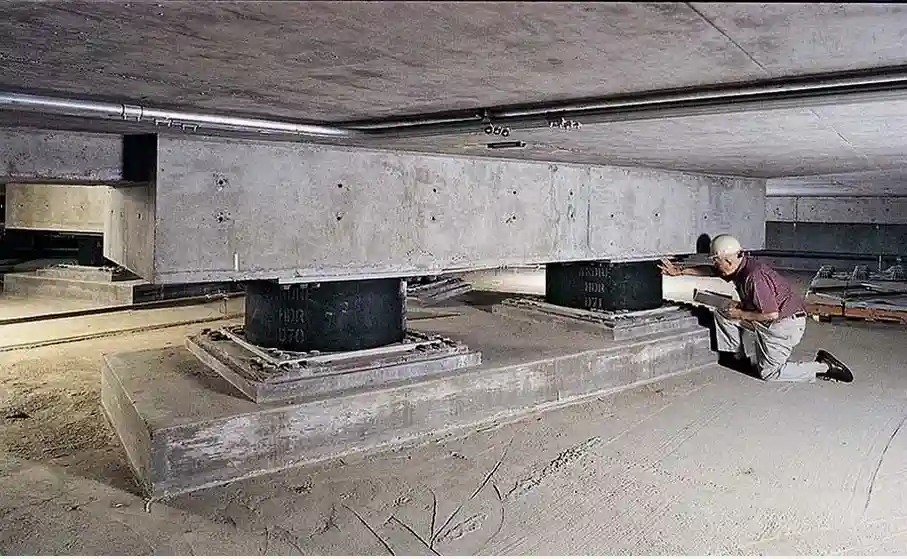
We have seen projects in Ottawa where the structural design was solid, yet the seismic strategy fell apart because the soil was treated as an afterthought. The mistake is assuming that firm glacial till at the surface means uniform stiffness all the way down. In reality, much of the city sits on sensitive Leda clay deposits that amplify ground motion in ways a fixed-base analysis cannot capture. Seismic microzonation studies across the National Capital Region have mapped these variations, but the real value comes when that data feeds directly into the isolator selection. For buildings near the Ottawa River or in the eastern Greenbelt, the spectral acceleration at longer periods can push a conventional structure beyond its ductility limits. We approach base isolation seismic design by first reconciling the NBCC 2020 uniform hazard spectra with site-specific borehole data, then testing lead-rubber and friction pendulum prototypes against the actual soil profile, not a generic site class. The goal is not just to meet code — it is to give the structure a predictable drift response when the Western Quebec Seismic Zone delivers a moderate-to-large event.
Ottawa’s seismic risk is not about magnitude alone — it is about the resonance between soft Leda clay, a stiff superstructure, and a long-duration intraplate motion that fixed-base design simply cannot address.