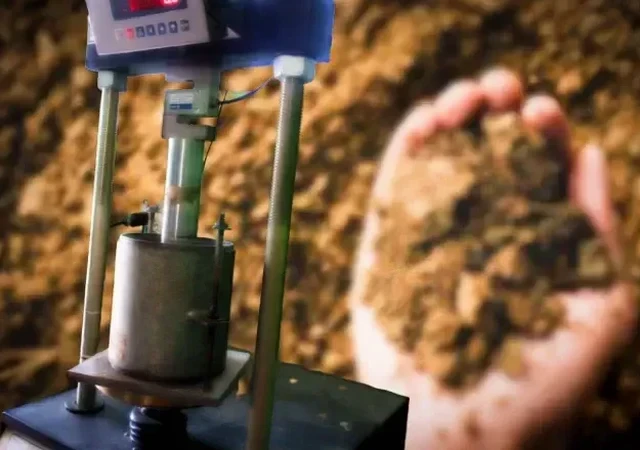
Ottawa’s pavement season is a battle against frost heave and spring thaw. The Leda clay that underlies much of the capital region swells when wet and loses strength abruptly. A laboratory CBR test strips away the variables of field moisture and compaction, giving you a direct measurement of subgrade bearing capacity under controlled, worst-case soaked conditions. Our technicians compact specimens at Optimum Moisture Content from a standard Proctor curve, then submerge them for 96 hours before the piston penetrates at 1.27 mm per minute. The result is a California Bearing Ratio that feeds directly into the AASHTO 1993 pavement design equation and the City of Ottawa’s OPSS.MUNI 501 specification. For granular base course quality control, we often pair CBR values with a grain size analysis to confirm compliance with OPSS 1010 gradation bands.
Soaked CBR values below 3% on Ottawa’s Leda clay are common; the test doesn’t lie, it just forces you to design a better pavement section.