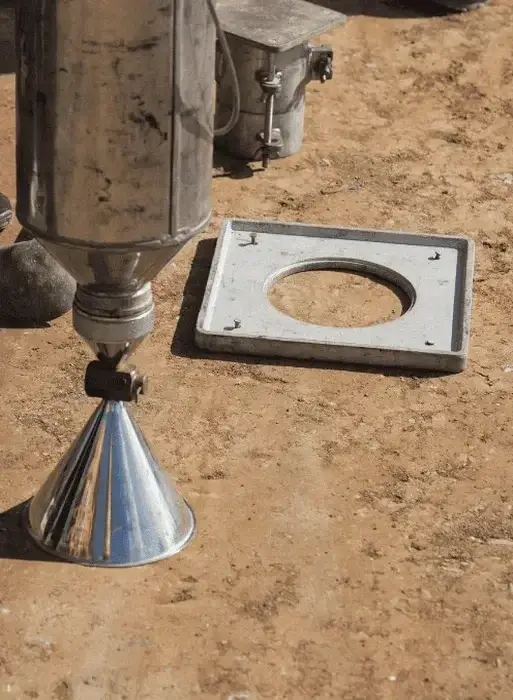
Ottawa’s geotechnical profile shifts dramatically within a few city blocks—from the dense, stony glacial till of the Merivale corridor to the notorious Leda clay deposits that underlie much of the east end and the NRC campus. Contractors who have worked the Confederation Heights area know that achieving uniform compaction on these sensitive marine silts is not a matter of running a roller for an extra pass; it demands precise, real-time density verification. The sand cone method (ASTM D1556) remains the definitive field check for backfill, subgrade, and granular base placement in the capital region, precisely because it provides a direct measurement of in-place density without the calibration assumptions that nuclear gauges require on heterogeneous materials. When a structural fill lift fails spec on a City of Ottawa project, it is typically the sand cone result that triggers rework—not the nuclear gauge. We run these tests across Barrhaven, Orléans, and Kanata, correlating results with Proctor compaction curves to confirm that the delivered relative compaction meets the 95% or 98% thresholds specified in OPSS.MUNI 206 and CSA A23.1.
On Ottawa’s varved clays, a 2% shortfall in compaction can double post-construction settlement within a single freeze-thaw cycle.