GEOTECHNICAL ENGINEERING
OTTAWA
HomeLaboratoryAtterberg limits

Atterberg Limits Testing in Ottawa: Reliable Lab Results

Rigorous testing. Clear reporting.

LEARN MORE

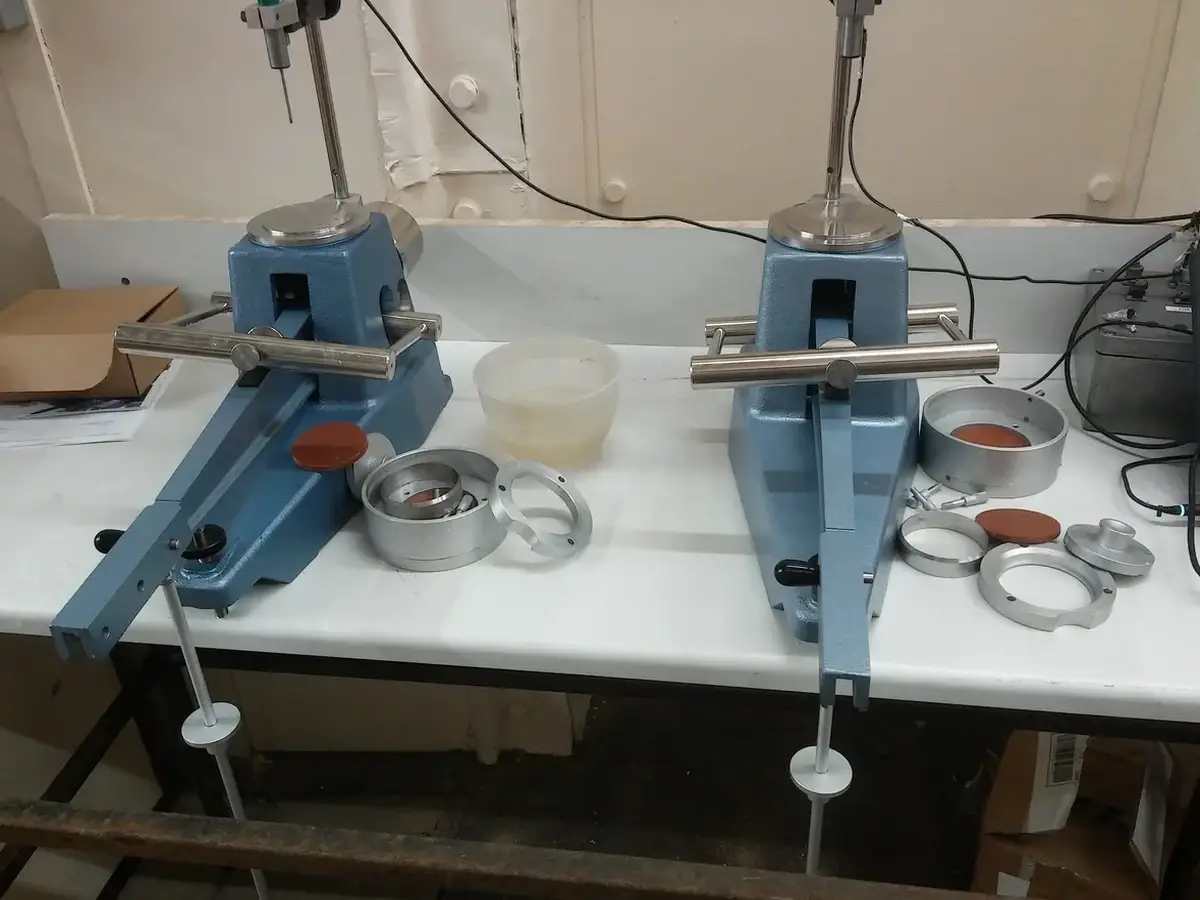
A recent excavation along Rideau Street hit a pocket of silty clay that turned into a sticky mess after two days of spring rain. The contractor had moisture content data, but no one knew the plasticity index, and the structural fill specification suddenly looked impossible to meet. That is exactly where our Atterberg limits testing in Ottawa becomes the difference between a delayed project and one that stays on schedule. Ottawa’s post-glacial Champlain Sea clays, especially in low-lying areas near the Rideau River, can swing from stiff to soft with small changes in water content. We run liquid limit, plastic limit, and plasticity index under ASTM D4318 using calibrated Casagrande cups and a rolling device that replicates the exact thread-rolling technique the standard demands, giving the design team a defensible number for soil classification and compaction control. For projects where the fines content points to potential shrink-swell behaviour, we often pair the Atterberg analysis with a grain size distribution test to lock down the full USCS classification before the earthworks begin.

A plasticity index above 30% in Ottawa’s Champlain Sea clay is a red flag for volume change, and we flag it the same day the test finishes.
Our service areas

Scope of work

ASTM D4318 is the governing standard in our Ottawa laboratory, and we follow the multi-point liquid limit method rather than the less reliable one-point shortcut. The test sequence starts with the portion passing the No. 40 sieve, mixed to a paste, and placed in the brass cup: the groove closure count at 25 blows defines the liquid limit, and the roll-up to a 3.2 mm thread without crumbling defines the plastic limit. In Ottawa’s Leda clay formations south of the Greenbelt, the liquid limit can exceed 60%, which pushes the material into CH territory under the Unified Soil Classification System and triggers specific provisions under the Ontario Building Code for foundation design. We report the plasticity index and the liquidity index because those two numbers tell the site supervisor exactly how close the in-situ material is to its liquid limit. Every sample logged at our lab is oven-dried at 110°C, weighed on a balance with 0.01 g readability, and run in duplicate: if the two liquid limit determinations differ by more than 4%, the entire sequence is repeated. That internal check is not optional, and it is one reason consulting engineers in the National Capital Region keep sending their Shelby tube samples here.
Atterberg Limits Testing in Ottawa: Reliable Lab Results
Technical reference — Ottawa

Area-specific notes

Ottawa sits on a basin of sensitive marine clay that can lose more than 80% of its undrained shear strength when remolded, a behaviour well documented in the Leda clay literature. A contractor who assumes a stiff silty clay based on a pocket penetrometer reading is taking a real gamble: a few percentage points of extra moisture from a water main break or a wet construction season can push the liquidity index above 1.0, and the material turns to slurry under foot traffic alone. Without Atterberg limits testing in Ottawa, the earthworks spec becomes guesswork. We have seen cases in Barrhaven where fill sourced from two different borrow pits looked identical in colour but had plasticity indices of 12% and 38% respectively, and the high-PI material failed compaction density checks on three consecutive lifts. The plasticity chart is not just an academic exercise: it directly dictates the maximum allowable slope angle in temporary cuts, the suitability of on-site material as clay liner, and the predicted settlement rate under embankment loading. The cost of a skipped Atterberg test is usually paid in truckloads of rejected fill and weeks of downtime.

Need a geotechnical assessment?

Reply within 24h.

Email: contact@geotechnicalengineering.vip

Watch how it works


Standards used

ASTM D4318-17e1, ASTM D2487 (USCS classification), Ontario Building Code (OBC) Section 4.2

Technical data


ParameterTypical value
Test standardASTM D4318-17e1
Liquid limit deviceCasagrande cup with flat grooving tool
Plastic limit determination3.2 mm thread rolling method
Reported indicesPlasticity index (PI), Liquidity index (LI), Consistency index (CI)
Sample preparationWet preparation, material passing No. 40 sieve
Oven drying temperature110 ± 5°C
Typical reporting turnaround2 to 3 business days for routine projects

Common questions

How much does Atterberg limits testing cost in Ottawa?

For a standard liquid limit and plastic limit determination under ASTM D4318, the fee ranges from CA$80 to CA$130 per sample depending on whether it is a multi-point or single-point protocol and the turnaround time required.

What sample quantity is needed for the test?

We require approximately 150 g of material passing the No. 40 sieve, taken from a representative portion of the fine-grained soil. The sample must be sealed in an airtight bag immediately after collection to preserve the natural moisture content.

How long does the Atterberg limits test take in the lab?

Routine specimens are reported within two to three business days. Expedited same-day or next-day reporting is available for active earthworks projects where the classification result is needed to approve fill placement.

Does the lab run the one-point liquid limit method?

We offer the one-point method primarily for production fill verification when the flow curve has already been established on the same material. For initial site characterization, we strongly recommend the full multi-point method to meet ASTM D4318 precision requirements.

Location and service area

We serve projects across Ottawa and surrounding areas.

View larger map