GEOTECHNICAL ENGINEERING
OTTAWA
HomeImprovementStone column design

Stone Column Design for Ottawa’s Leda Clay: Improvement That Works

Rigorous testing. Clear reporting.

LEARN MORE

Ottawa sits on one of the continent’s most challenging foundation soils: Champlain Sea clay, commonly called Leda clay. This post-glacial marine deposit covers much of the urban area south of the Ottawa River and can lose over 90 percent of its strength when disturbed. In Kanata, Barrhaven, and the Greenbelt fringe, soft compressible clays extend 20 to 30 meters deep before hitting till or bedrock. A conventional fill-and-surcharge approach often takes too long or risks excessive settlement under new loading. Stone column design offers a practical alternative—installing compacted gravel columns through the soft zone to accelerate drainage and reinforce the matrix. The result is a stiffer composite ground that limits total and differential settlement while respecting the sensitivity of the native clay. Before committing to a Improvement scheme, we typically pair the design investigation with CPT testing to map layer continuity and undrained shear strength, and complement it with triaxial lab work when column confinement needs verification.

A well-executed stone column program in Leda clay can shift the site class from E to D under NBCC 2020, directly reducing seismic demands on the structure.
Our service areas

Scope of work

CSA A23.3 and the Ontario Building Code reference NBCC 2020 for seismic design, and Section 4.2 of the NBCC structural commentaries provides guidance on Improvement in moderate seismicity zones. Ottawa’s fundamental period site class often shifts from Class E to Class D once stone columns are installed, which can reduce the seismic base shear demand on the superstructure. That classification change matters: Class E sites in the Ottawa valley amplify long-period ground motion, and moving to Class D can mean the difference between acceptable drift and costly structural upgrades. Our design approach follows the Priebe method to estimate settlement reduction and bearing capacity increase, then cross-checks results with finite element models when column-to-column interaction is critical. Key design variables include area replacement ratio—usually between 10 and 25 percent for typical commercial buildings—column diameter, grid spacing, and the gravel friction angle, which we confirm through large-scale direct shear tests. In eastern Ontario’s climate, freeze-thaw cycling in the upper 1.5 meters demands a well-graded, clean stone that resists degradation; we specify gradation bands aligned with OPSS 1010 granular B Type II. For projects near the Rideau River where groundwater is within 2 meters of grade, we integrate a working platform and sometimes a bridging layer to maintain stability during installation.
Stone Column Design for Ottawa’s Leda Clay: Improvement That Works
Technical reference — Ottawa

Area-specific notes

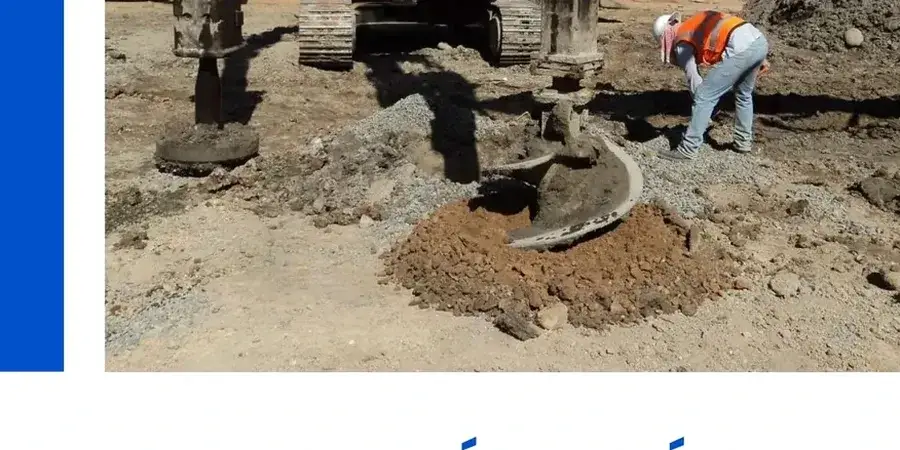
At roughly 70 meters above sea level, much of urban Ottawa occupies a flat clay plain where the sensitive Leda formation is prone to large strength loss if remolded during installation. The 2010 Val-des-Bois earthquake—a magnitude 5.0 event centered about 60 kilometers northeast of the city—shook the capital region and reminded engineers that intraplate seismicity is real, even if recurrence intervals are long. A stone column design that looks fine on paper can fail during construction if the vibroflot advances too fast, triggering excess pore pressure and localized mud-waving. We’ve seen sites in Orléans where a too-aggressive installation schedule remolded the clay and collapsed adjacent column holes before stone could be introduced. That’s why our team specifies bottom-feed methods and real-time ammeter monitoring to control penetration and withdrawal rates. Sequencing matters too: we stage column installation from the stiffest edge inward, maintaining a minimum 48-hour rest period before loading the improved zone with fill or equipment.

Need a geotechnical assessment?

Reply within 24h.

Email: contact@geotechnicalengineering.vip

Watch how it works


Standards used

NBCC 2020 (Seismic site classification, Section 4.1.8.4), CSA A23.3-19 (Design of concrete structures, foundation provisions), ASTM D6913/D6913M-17 (Particle-size distribution of soils), OPSS 1010 (Ontario Provincial Standard Specification for aggregates), FHWA NHI-16-027 (Improvement methods, stone columns)

Technical data


ParameterTypical value
Typical column diameter600 to 1000 mm
Area replacement ratio range (Ottawa clay)10 to 25 percent
Settlement reduction factor (Priebe)2 to 4 typical
Gravel friction angle (design)38 to 42 degrees
Installation depth typical in Leda clay8 to 18 m
Post-installation modulus improvement2x to 5x native clay
Vibro-replacement penetration rate (clay)0.3 to 0.8 m/min

Common questions

What does stone column design cost for a typical Ottawa commercial lot?

Design fees in the Ottawa area normally run between CA$2,200 and CA$7,990 depending on the complexity of the soil profile, the number of columns, and whether finite element modeling is needed. A straightforward single-storey commercial pad on 2 to 3 meters of fill over Leda clay sits at the lower end. A multi-storey structure requiring seismic site-class confirmation and detailed interaction analysis falls toward the upper end.

How do stone columns perform in Ottawa’s Leda clay compared to rigid inclusions?

Stone columns improve the clay through densification and drainage, creating a composite mass. In Leda clay the improvement is mainly by reinforcement—because the clay is too fine to densify significantly—so settlement reduction factors are lower than in sandy soils. Rigid inclusions transfer load to a firm bearing layer and control settlement through stiffness contrast rather than mass improvement. We often recommend stone columns when the objective is liquefaction mitigation or global site-class improvement under NBCC 2020, and rigid inclusions when total settlement must stay under 25 mm.

What investigation data does the design team need before starting?

We need CPT soundings with pore pressure measurement to map tip resistance, sleeve friction, and equilibrium pore pressure, plus at least one soil boring with thin-wall Shelby tube samples for index and triaxial testing. If the site is near the Carp or Hazeldean escarpment where bedrock is shallow, bedrock depth confirmation by seismic refraction or probe refusal is essential. Shear wave velocity profiles are also required for the NBCC site class determination.

Location and service area

We serve projects across Ottawa and surrounding areas.

View larger map