GEOTECHNICAL ENGINEERING
OTTAWA
HomeLaboratoryTriaxial test

Triaxial Tests in Ottawa: Shear Strength for Foundation Engineering on Glacial Soils

Rigorous testing. Clear reporting.

LEARN MORE

A lot of what we see in Ottawa geotechnical reports underestimates the complexity of the local overconsolidated clays until a proper triaxial test is run. You can have decent SPT numbers in the field and still end up with unexpected settlement because the stress history of Champlain Sea deposits isn't obvious from index tests alone. The atterberg limits lab work gives you the classification, sure, but for the effective friction angle and undrained shear strength that actually drive deep foundation design—or the stability analysis on an excavation near the Rideau Canal—the triaxial test is non-negotiable. Our team works with local consulting firms who know that a consolidated-undrained test with pore pressure measurement tells a different story than a quick unconfined compression on a Shelby tube sample; we see it every season, especially in the softer zones east toward Orleans where the clay sensitivity runs high.

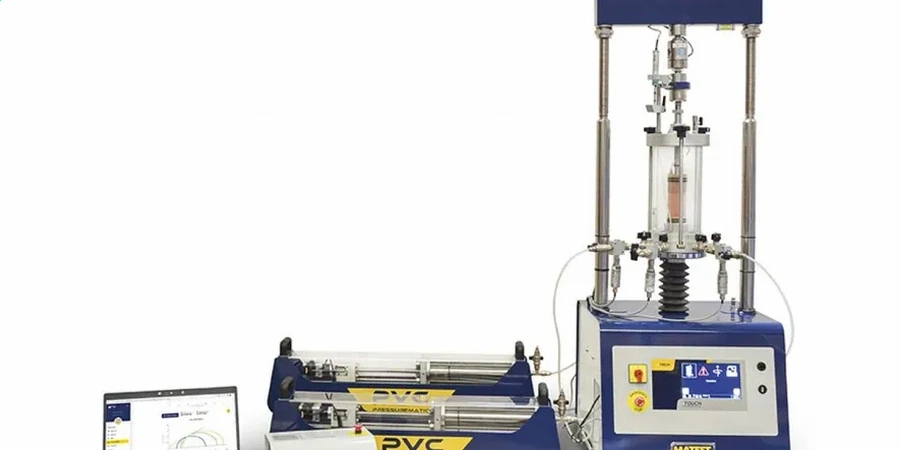
A consolidated-undrained triaxial test with pore pressure measurement on Leda clay reveals strength ratios that index tests simply can't predict.
Our service areas

Scope of work

ASTM D4767 and D2850 are the backbone of every triaxial program we run, and in Ottawa, the CSA A23.3 reference to these standards for concrete structures means the data has to be defensible if it's going into a foundation design. We run effective stress tests with full saturation checks and back-pressure saturation on samples trimmed from thin-walled tube specimens—the key is getting that B-value above 0.95 before shear, otherwise you're measuring air compressibility, not soil behavior. For the sensitive Leda clay that underlies much of the downtown core, we often pair consolidated-undrained triaxial testing with cpt-test profiling so the in-situ tip resistance and pore pressure dissipation curves can be correlated directly with lab-derived strength envelopes; it's a reality check that saves projects from over-design—or worse, under-design—when the contractual schedule pushes for fast answers. Stress paths plotted in p'-q space are standard in our deliverables, not an extra.
Triaxial Tests in Ottawa: Shear Strength for Foundation Engineering on Glacial Soils
Technical reference — Ottawa

Area-specific notes

Ottawa sits on a mix of Champlain Sea clays, glacial till, and occasional bedrock outcrops—the clays in particular can lose more than 60% of their remolded strength, and that sensitivity is a risk factor you don't want to learn about during excavation. The Triaxial test is what quantifies the strain-softening behavior; we've seen CU tests on samples from near the Ottawa River where the peak deviator stress drops off sharply after just 2% axial strain, and if that isn't modeled in a slope stability analysis for a cut near the Queensway, the factor of safety looks fine on paper until the first heavy rain. Pore pressure buildup during undrained loading is another thing—without measured A and B parameters from the lab, assumptions about excess pore pressure in your finite element model are just guesses.

Need a geotechnical assessment?

Reply within 24h.

Email: contact@geotechnicalengineering.vip

Watch how it works


Standards used

ASTM D4767-11 (Consolidated Undrained Triaxial Compression Test), CSA + ASTM D2850 (Unconsolidated Undrained Triaxial Compression Test), CSA A23.3-14 (Design of Concrete Structures, referencing ASTM soil parameters), ASTM D7181-20 (Consolidated Drained Triaxial Compression Test)

Technical data


ParameterTypical value
Test typesUU, CU, CD, with pore pressure measurement
Specimen diameter35 mm to 100 mm, site-specific selection
Confining pressure rangeUp to 1500 kPa, multi-stage available
Saturation methodBack-pressure saturation, B-value > 0.95
Strain rate (CU, CD)0.05% to 0.5% per minute per ASTM D4767
ReportingMohr-Coulomb envelopes, stress paths, E50, Su
Sample preparationTrimmed from Shelby tubes or block samples

Common questions

What's the typical cost range for a triaxial test program in Ottawa?

For a single Consolidated-Undrained triaxial test with pore pressure measurement, budget between CA$2,790 and CA$3,590 per specimen depending on the number of confining stresses and whether multi-stage loading is used. A full project program with three CU tests at different depths plus one UU test typically falls in that per-test range, with volume discounts applied for larger geotechnical investigations.

How long does it take to get triaxial test results in Ottawa?

A standard CU triaxial test with full saturation and consolidation takes about 7 to 10 business days from sample arrival to final report. The consolidation phase alone on a Leda clay specimen can run 24 to 48 hours depending on hydraulic conductivity; we don't rush this because incomplete consolidation leads to misleading effective stress envelopes. Expedited schedules are possible with advance coordination.

Do you need Shelby tube samples for triaxial testing, or can we use split spoon samples?

Shelby tube samples are the minimum standard for triaxial specimens because the undisturbed structure of the soil has to be preserved—split spoon samples from an SPT are too disturbed to give reliable strength parameters. For sensitive Ottawa clays, we strongly recommend thin-walled Shelby tubes pushed with a smooth, continuous advance, and the samples should be transported vertically, stored at field moisture, and trimmed within days of extraction to minimize swelling and moisture loss.

Location and service area

We serve projects across Ottawa and surrounding areas.

View larger map