GEOTECHNICAL ENGINEERING
OTTAWA
HomeLaboratoryProctor test (Standard or Modified)

Proctor Testing in Ottawa: Site Compaction Verification (Standard & Modified)

Rigorous testing. Clear reporting.

LEARN MORE

A contractor on a Rideau Street mid-rise was losing sleep over foundation backfill last winter. The soil was a mix of silty sand and chunks of limestone till, and the inspector flagged inconsistent density readings from the field crew. We ran a series of modified Proctor tests on samples taken from the lift, cross-referenced them with field density data from a sand cone density test, and identified the optimum moisture content that the crew had been missing by almost three percent. That adjustment saved them from re-compacting two floors' worth of backfill before the first big freeze. In Ottawa, where native soils range from sensitive Leda clay in the east to dense glacial till in the west, the Proctor test is not just a box to check—it is the reference curve that every compaction spec hangs on.

Compaction without a Proctor curve is just guesswork—and guesswork in Ottawa's silty till costs re-compaction by the metre.
Our service areas

Scope of work

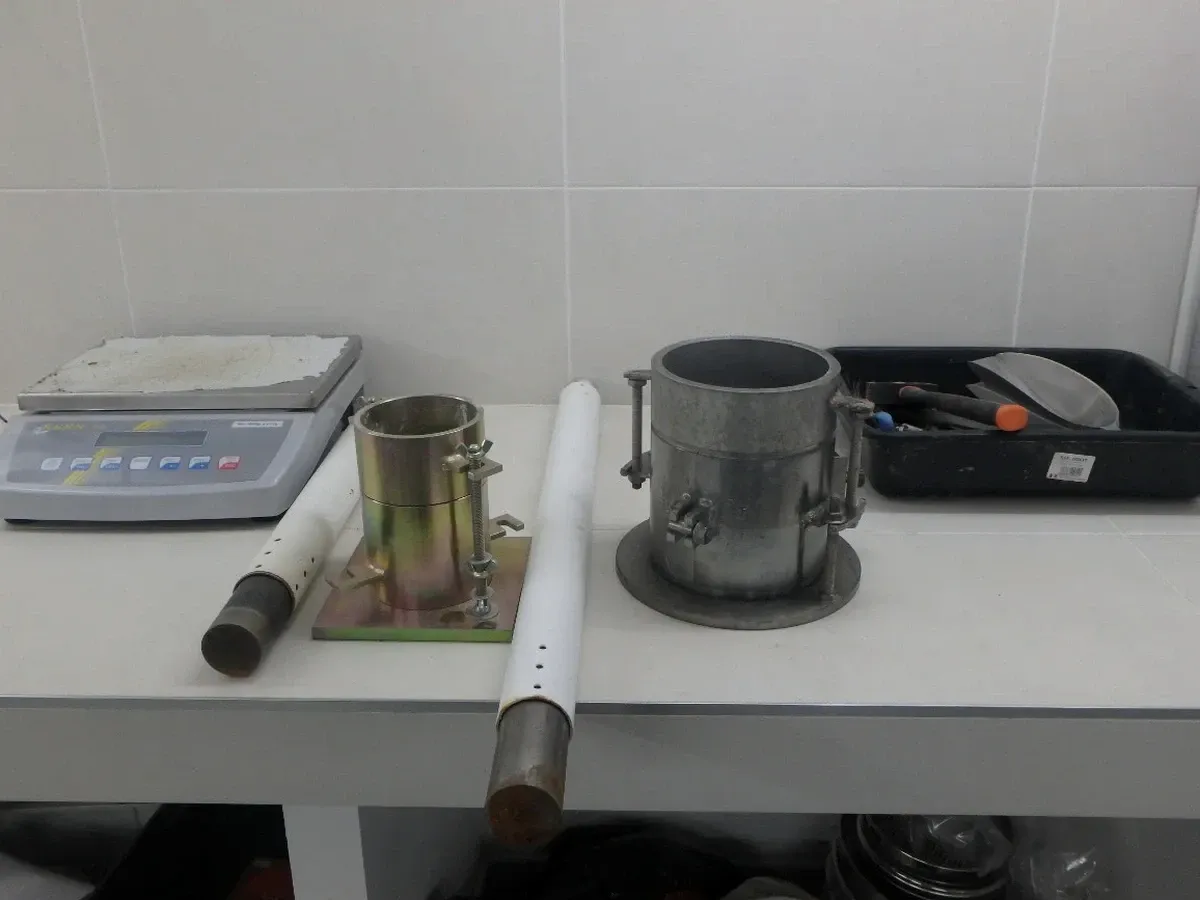
The National Building Code of Canada references CSA A23.3 for concrete structures, but the backfill and subgrade beneath those structures are governed by ASTM D698 (Standard Proctor) and ASTM D1557 (Modified Proctor), both cited in Ontario Provincial Standard Specifications (OPSS) for granular and cohesive materials. The key difference is compactive effort: Standard Proctor uses a 5.5-lb hammer dropped 12 inches in three layers, while Modified uses a 10-lb hammer dropped 18 inches in five layers. For Ottawa's typical silty clays and glacial tills, the Modified curve often yields maximum dry densities between 118 and 134 pcf, with optimum moisture hovering around 10 to 14 percent. When the job is a deep excavation in the downtown core, we often pair the Proctor with a triaxial shear strength profile to confirm that the compacted fill will carry the lateral loads from adjacent heritage buildings without excessive settlement. Every curve we produce is backed by our ISO 17025-accredited lab, with daily calibration checks on the mechanical hammer and the moisture oven.
Proctor Testing in Ottawa: Site Compaction Verification (Standard & Modified)
Technical reference — Ottawa

Area-specific notes

The mechanical hammer in our Ottawa lab is a calibrated automatic compactor that delivers exactly 25 blows per layer, eliminating the variability you get from a tired technician with a hand rammer on a Friday afternoon. That consistency matters when you are working with moisture-sensitive Leda clay from the city's east-end deposits. If the Proctor curve is off by even one percent in optimum moisture, the field crew ends up over-compacting or under-compacting, and the proof-roll fails. We have seen the fallout: a Kanata warehouse project where the floor slab cracked within six months because the granular base was compacted wet of optimum, trapping pore pressure that migrated upward through the vapour barrier. The fix was demolition and re-pour—a CA$200,000 lesson. The Proctor test is the cheapest insurance policy on any Ottawa compaction job, and skipping it is the most expensive shortcut you can take.

Need a geotechnical assessment?

Reply within 24h.

Email: contact@geotechnicalengineering.vip

Standards used


ASTM D698: Standard Test Methods for Laboratory Compaction Characteristics of Soil Using Standard Effort, ASTM D1557: Standard Test Methods for Laboratory Compaction Characteristics of Soil Using Modified Effort, OPSS 501: Material Specification for Compacting, CSA A23.3: Design of Concrete Structures (backfill and subgrade context), ASTM D2216: Laboratory Determination of Water (Moisture) Content

Technical data

ParameterTypical value
Applicable standardsASTM D698, ASTM D1557, OPSS 501
Hammer mass (Standard/Modified)5.5 lb / 10 lb
Drop height (Standard/Modified)12 in / 18 in
Number of layers (Standard/Modified)3 / 5
Typical max dry density (Ottawa till)118–134 pcf (1.89–2.15 g/cm³)
Typical optimum moisture (Ottawa soils)8–16%
Sample size requirement20–25 kg disturbed material
Report turnaround24–48 hours

Common questions


What does a Proctor test cost in Ottawa?

Standard Proctor (ASTM D698) runs between CA$140 and CA$190 per sample, while Modified Proctor (ASTM D1557) ranges from CA$210 to CA$270. The price includes moisture content determination and the complete plotted curve. Volume discounts apply when you send multiple samples from the same site.

How much soil do I need to send for a Proctor test?

We need at least 20 to 25 kilograms of disturbed, representative material. For Ottawa's glacial till, if there are cobbles larger than 3/4 inch, please send extra so we can scalp the sample to the correct fraction per ASTM D698.

Can you run a one-point Proctor for faster field checks?

Yes, a one-point Proctor can be useful for quality control when the material is consistent and we already have a full family of curves established for the borrow source. We run it against the existing curve and report the percent compaction within the same day if samples arrive before noon.

Which Proctor method does the City of Ottawa require for subdivision roads?

The City of Ottawa standard drawings and OPSS 501 typically specify Modified Proctor (ASTM D1557) for subgrade and granular base under flexible and rigid pavement. Standard Proctor is usually reserved for landscaping and non-structural fills, but always check the project-specific geotechnical report.

Location and service area

We serve projects across Ottawa and surrounding areas.

View larger map