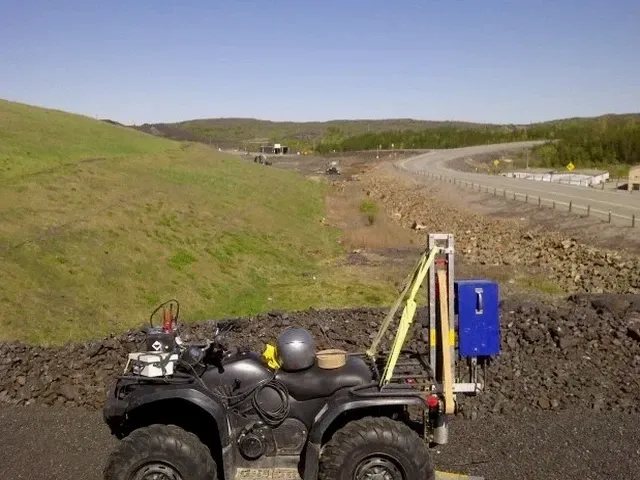
In Ottawa, the contrast between the shallow Paleozoic bedrock of the Gatineau Hills and the deep Champlain Sea sediments in the east end creates significant uncertainty for foundation design. We see this every week: a site in Kanata hits limestone at three meters, while a project near the Rideau River encounters thirty meters of sensitive Leda clay before reaching competent rock. Seismic tomography, both refraction and reflection, provides a continuous subsurface velocity model that ties these transitions together. The method is particularly effective here because the acoustic impedance contrast between the overburden and the limestone or Precambrian basement is strong, yielding clean first arrivals and interpretable reflection profiles. Our field crew uses a 24-channel seismograph with geophone spacings adapted to the target depth, ranging from two meters for pavement investigations up to ten meters for regional bedrock mapping, always following the ASTM D5777 guidelines for seismic refraction to ensure data quality and repeatability.
Seismic velocity models reveal bedrock geometry that a grid of boreholes can miss entirely, especially in the irregular limestone terrain of the Ottawa Valley.